
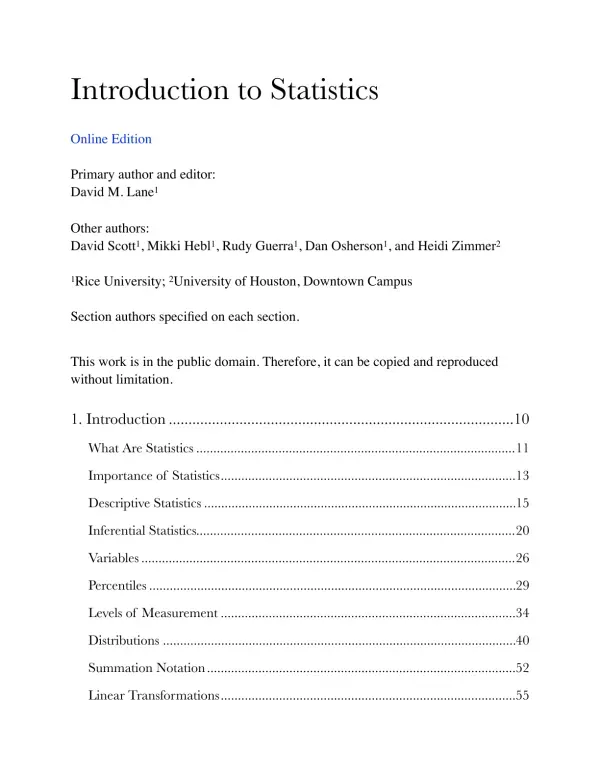
Introduction to Statistics
Document information
| Author | David M. Lane |
| School | Rice University, University of Houston, Downtown Campus |
| Major | Statistics |
| Document type | Online Textbook |
| Language | English |
| Format | |
| Size | 30.14 MB |
Summary
I.The Importance of Critical Evaluation of Statistics
This section emphasizes the crucial role of critical thinking when evaluating statistical claims. It warns against accepting numbers at face value, highlighting the potential for manipulation and misleading information. Understanding basic statistical analysis is presented as a key tool for making informed decisions and avoiding being misled by faulty reasoning. The quote, “There are three kinds of lies—lies, damned lies, and statistics,” underscores the necessity for statistical literacy.
1. The Vulnerability of Uncritical Acceptance of Statistical Claims
This section begins by emphasizing the importance of critical evaluation when encountering statistical information. It argues that a lack of critical thinking leaves individuals susceptible to manipulation and poor decision-making. The text uses the example of interracial marriage statistics to illustrate this point. A simple increase in the percentage of interracial marriages from 1% to 1.75% over 25 years is presented as insufficient evidence to conclude widespread acceptance of such unions, highlighting the need for a more thorough examination of the data and its context. The section stresses that statistics, while often used to lend credibility, can be easily manipulated or misinterpreted, leading to regrettable choices. The need for a deeper understanding of statistical methods and data sources to properly assess claims is paramount. It highlights the famous quote by Mark Twain, attributing it to Benjamin Disraeli: “There are three kinds of lies—lies, damned lies, and statistics,” emphasizing the critical need for a skeptical approach to statistical data presented without supporting context or rigorous methodology.
2. Statistics as Tools for Informed Decision Making
The core argument of this section centers on the idea that acquiring statistical skills empowers individuals to take control of their lives. The ability to critically evaluate data and claims is presented as crucial for navigating the constant barrage of information in daily life. The text contends that statistics provides the necessary tools to intelligently assess information, transforming passive consumers of data into active and informed decision-makers. While acknowledging that mastering statistics is not a panacea for all life's challenges, it is presented as a major step towards self-empowerment. This emphasis on active engagement and critical evaluation is further reinforced by advocating a questioning approach towards encountered statistics. The text urges readers to move beyond passively accepting numbers and findings, promoting active inquiry into the sources, generation methods, and inherent limitations of the statistical data encountered.
3. The Nature of Data and Descriptive Statistics
This subsection introduces the concept of 'data' as information collected from various sources, such as experiments, surveys, or historical records. The distinction between singular 'datum' and plural 'data' is clarified. The focus then shifts to descriptive statistics, defined as numerical summaries computed from data. Examples include calculating the percentage of birth certificates issued in New York State or the average age of mothers. The versatility of descriptive statistics is illustrated through their application in sports analytics, using examples of player shooting percentages and Olympic marathon winning times. The section makes it clear that while descriptive statistics offer a useful summary of data, they do not necessarily explain the reasons behind the observed numbers. An example analyzing the disparity in the male-to-female ratio in certain cities highlights this limitation, emphasizing that descriptive statistics, while informative, often leave room for further investigation and potential contextual explanations.
II. Descriptive Statistics Summarizing Data
This section introduces descriptive statistics, focusing on how they summarize data. Examples include calculating the average age of mothers from birth certificates, analyzing winning times in Olympic marathons, and using shooting percentages in sports. The section highlights that while descriptive statistics provide a snapshot, they don't fully explain underlying causes. For instance, differences in male and female populations in certain cities (like Sarasota, Florida) are noted, but further data analysis is needed to explain these differences. The analysis of Olympic marathon winning times (men's and women's) illustrates the use of mean winning times to understand trends and improvements over time.
1. Defining and Illustrating Descriptive Statistics
This section introduces descriptive statistics as numerical summaries of data. The text explains that descriptive statistics are used to provide a concise overview of collected information. Examples include calculating the percentage of birth certificates issued in a specific state or determining the average age of mothers from birth certificate data. The concept is further exemplified by its widespread use in sports, such as calculating shooting percentages in basketball or analyzing winning times in the Olympic marathon. The section clarifies that while these statistics offer valuable summaries, they don't inherently explain the underlying reasons for the observed patterns. The text highlights this limitation using the example of differing male and female population numbers in specific cities, suggesting that further analysis is needed to identify the causal factors behind the observed disparity. The diverse applications and limitations of descriptive statistics within various contexts are emphasized.
2. Descriptive Statistics in the Analysis of Olympic Marathon Data
This section provides a detailed example of applying descriptive statistics to a real-world dataset: Olympic marathon winning times. It notes that data for both men and women (since 1984) are available, spanning over a century of competition (starting from the first modern Olympics in 1896). The analysis focuses on calculating mean winning times, dividing the men's data into two periods to identify trends in improvement over time. The significant difference between the mean winning times in the earlier and later periods is highlighted, raising questions about the causes of this change – whether it reflects genuine improvements in runners' performance or is merely a result of random fluctuations. This example serves to show how descriptive statistics can be used to reveal trends and patterns, while simultaneously emphasizing that these statistics alone cannot definitively answer causal questions. Further investigation using more sophisticated statistical methods is required to fully explain these observations.
3. Limitations of Descriptive Statistics The Need for Deeper Analysis
This section addresses the inherent limitations of descriptive statistics. While useful for summarizing data, descriptive statistics alone are insufficient for fully understanding the implications of the data. The example of the Olympic marathon data illustrates this point: a significant difference in mean winning times between two periods is observed, but descriptive statistics don't provide a definitive answer as to why this difference exists. The text points out that such differences may be due to improved training, changes in running technology, or simply chance variation. The possibility of confounding factors or the absence of crucial information is also highlighted. The section uses the example of comparing the number of men and women in Florida to further emphasize this limitation. While observing a discrepancy, the text explains that merely computing means doesn’t fully explain the underlying reasons for the disparity, underscoring the need for additional data and potentially more advanced statistical techniques to gain a deeper understanding of the situation. This emphasizes that descriptive statistics provide a starting point for analysis, not a complete explanation of the underlying phenomena.
III. Inferential Statistics From Samples to Populations
This section contrasts descriptive statistics with inferential statistics. Inferential statistics uses data from a sample to make predictions or inferences about a larger population. The section discusses sampling methods, particularly simple random sampling, and the challenges of ensuring a representative sample. Examples are given, including surveys on voting procedures and studies on twins and the impact of sample size on the accuracy of generalizations. The importance of random assignment in experimental research is also emphasized.
1. Inferential Statistics From Sample to Population
This section introduces inferential statistics as the branch of statistics that uses sample data to make inferences about a larger population. It contrasts with descriptive statistics, which simply summarize the observed data. The text emphasizes that it is often impractical to collect data from an entire population (e.g., asking every American about voting fairness). Instead, researchers collect data from a smaller, representative sample and then use inferential statistics to generalize their findings to the broader population. The section explains that the mathematical procedures for making these generalizations fall under the umbrella of inferential statistics. The core concept is that by carefully selecting a sample and employing appropriate statistical methods, researchers can draw reasonably accurate conclusions about the characteristics of the larger population from which the sample is drawn. The inherent limitations of relying on sample data are implicitly acknowledged, setting the stage for subsequent discussions of sampling techniques and their impact on the reliability of inferences.
2. Sampling Methods and the Importance of Randomness
This section delves into various sampling strategies, focusing on the importance of random sampling. Simple random sampling, where every member of the population has an equal chance of selection, is presented as the most straightforward approach. The concept of independence between selections is also explained; the choice of one member should not influence the probability of selecting any other member. The text uses an example to illustrate this, emphasizing that deviations from simple random sampling can introduce bias. A contrasting example demonstrates non-random sampling: a researcher selecting twins based on their last names (Z and every other B) introduces bias. This illustrates how non-random selection procedures can skew the sample and lead to inaccurate inferences about the population. The importance of achieving a representative sample, where the characteristics of the sample accurately reflect those of the population, is highlighted, although the text acknowledges that even random sampling doesn't guarantee perfect representation, particularly with smaller sample sizes. The influence of sample size on the accuracy of inferences is mentioned, suggesting that larger samples generally yield more reliable results.
3. Random Assignment in Experimental Research and Inferential Statistics
This section extends the discussion to experimental research, highlighting the role of inferential statistics and random assignment. It notes that in many experiments, the population of interest is hypothetical (e.g., there is no existing population of individuals taking a new drug). In such cases, researchers define a target population and draw a random sample. This sample is then randomly divided into groups (treatment and control) through a process called random assignment. Random assignment is crucial for ensuring that any observed differences between groups are attributable to the treatment and not to pre-existing differences between participants. The section emphasizes that the objective is to make inferences about the hypothetical population based on the results obtained from the randomly assigned sample groups. The use of inferential statistics to analyze data obtained from these groups, and to generalize the findings to the larger hypothetical population, is implicitly highlighted. The example of a study testing the effectiveness of a new antidepressant drug compared to a placebo illustrates the importance of random assignment in experimental design and the application of inferential statistics in drawing conclusions.
IV.Understanding Measurement Scales and Their Implications
This section covers different types of measurement scales (nominal, ordinal, interval, ratio) and the errors that can arise from misusing them. The importance of appropriate measurement tools for different variables is discussed (e.g., stopwatches for time, rating scales for attitudes). Failing to understand the properties of different scales can lead to incorrect interpretations and flawed conclusions. Examples use response times in an experiment to illustrate the distinctions between continuous and discrete data.
1. The Importance of Measurement Scales in Statistical Analysis
This section underscores the critical role of measurement scales in statistical analysis. It emphasizes that the method of measurement depends entirely on the type of variable being analyzed. Different variables require different measurement approaches; for instance, a stopwatch is suitable for measuring response time, while a rating scale is more appropriate for assessing attitudes. The text uses examples such as measuring the time taken to respond to a stimulus versus measuring someone's attitude toward a political candidate to highlight the need for choosing the right measurement technique. The accuracy and reliability of statistical analysis are directly linked to the proper application of measurement scales; using an inappropriate scale can lead to errors and misinterpretations of the data. This sets the stage for a more detailed discussion of different types of measurement scales and their respective properties, which are crucial for selecting and applying appropriate statistical methods.
2. Distinguishing Between Nominal Ordinal Interval and Ratio Scales
This section differentiates between various types of measurement scales: nominal, ordinal, interval, and ratio. Nominal scales categorize data without any inherent order (e.g., favorite color). Ordinal scales involve ordered categories, but the differences between categories may not be equal (e.g., satisfaction levels: dissatisfied, somewhat satisfied, satisfied, very satisfied). Interval scales have equal intervals between values, but lack a true zero point (e.g., temperature in Fahrenheit). Ratio scales have equal intervals and a true zero point, allowing for meaningful ratio comparisons (e.g., weight). The text emphasizes that the type of scale used determines the kinds of statistical analyses that are appropriate. For instance, calculating ratios is only meaningful with ratio scales. Misunderstanding the properties of these different scales can result in flawed analysis and incorrect interpretations of the data. The example of temperature scales (Fahrenheit) illustrates the consequences of assuming a true zero point where none exists, emphasizing that failing to understand the fundamental distinctions between these scales directly impacts the validity and reliability of statistical inferences.
3. Continuous vs. Discrete Data and Implications for Measurement
This subsection examines the distinction between continuous and discrete variables. Continuous variables can take on any value within a given range (e.g., time measured to many decimal places), while discrete variables can only take on specific values (e.g., the number of children in a family). The text uses an example of measuring response time in an experiment to illustrate continuous data, noting that with precise measurement, no two response times are likely to be exactly the same. For continuous data, concepts like frequency distributions are crucial for statistical analysis. The difference between continuous and discrete variables affects how the data is represented and the type of statistical techniques used for analysis. The concept of probability density, while not discussed in detail, is introduced as a key concept for understanding continuous distributions. The text emphasizes the importance of selecting an appropriate level of precision in measurement according to the nature of the variable being studied to accurately capture the information without unnecessary complexity.
V.Data Visualization Graphs and Charts
This section focuses on effective ways to visualize data using various graphs and charts. It explains the use of bar charts, pie charts, frequency polygons, histograms, box plots, and line graphs to represent and compare data distributions. The section emphasizes the potential for misrepresentation through improper scaling, three-dimensional charts, or misleading image choices within bar charts. Examples include data on iMac buyers categorized by previous computer use, and a comparison of online card game players on different days.
1. Graphical Methods for Qualitative Data
This section introduces graphical methods for displaying data, beginning with qualitative data—data without a pre-established order. The text contrasts this with quantitative data, which has a natural order (like numbers). An example of qualitative data is the type of computer a person previously owned (Windows or Macintosh). The key point is that there's no inherent order between these categories. The section focuses on the appropriate use of graphs for visualizing such data. The discussion implies the use of bar charts or pie charts as suitable options for representing qualitative data, emphasizing the importance of clear and accurate representation of categories without imposing artificial ordering. The section also cautions against misinterpreting pie charts based on small sample sizes. If only a few observations are available, presenting percentages can be misleading. It recommends using actual frequencies instead of percentages for better clarity and avoiding the misrepresentation of data arising from small samples where chance variations can significantly skew the results.
2. Bar Charts and Their Potential for Misrepresentation
This section focuses on bar charts and discusses their use in illustrating differences between distributions. The example of card game players on a Sunday and Wednesday highlights the effectiveness of bar charts in revealing these differences; the chart clearly shows variations in the number of players across different games and days. However, the text also cautions against certain pitfalls in creating bar charts. It warns against the use of three-dimensional versions, which can distort the visual representation. The section also highlights the misleading effect of using images within the bars instead of plain bars. The use of images can exaggerate differences in size, obscuring the true differences in values. Another common error discussed is setting the baseline to a value other than zero, making differences appear more significant than they actually are. This section emphasizes the importance of clear and accurate chart construction to avoid misleading interpretations; the focus lies on ensuring that visual representations are faithful to the underlying data, highlighting the potential for visual distortion through design choices and the necessity of avoiding deceptive practices in data visualization.
3. Other Graphical Representations Stem and Leaf Displays Frequency Polygons and Box Plots
Beyond bar charts and pie charts, this section briefly introduces other graphical methods for data visualization. Stem-and-leaf displays are mentioned as a way to organize numerical data, providing a concise representation of the data's distribution. The section also discusses frequency polygons as useful tools for comparing distributions by overlaying multiple polygons. An example of comparing response times for moving a computer cursor to targets of different sizes is provided. This highlights the capacity of frequency polygons to illustrate differences in distributions. Finally, the section introduces box plots as a valuable tool for identifying outliers and comparing distributions. An experiment measuring the time taken by men and women to name colors is used to explain the concept of parallel box plots for comparison. The section notes that although box plots are helpful for summarizing key aspects of a distribution, they don't reveal all the details; more comprehensive methods like histograms and stem-and-leaf displays are needed for a thorough analysis. The overall focus is on the versatility of different graphical techniques for data representation and the importance of choosing an appropriate method based on the type of data and the insights sought.
4. Line Graphs and Their Appropriate Use in Showing Changes Over Time
This section introduces line graphs and their suitability for representing data where both axes involve ordered variables, particularly for tracking changes over time. It contrasts line graphs with bar charts, explaining that while bar charts can also be used to visualize data over time, line graphs are often more effective in illustrating trends. The example given involves visualizing the percent change in the Consumer Price Index (CPI) over time, highlighting the clear depiction of progression and fluctuations. The section also demonstrates the use of line graphs to compare changes in multiple variables over time; it uses an example of five CPI components to show how line graphs effectively reveal relative changes and overall trends in multiple datasets simultaneously. The capacity of line graphs to present multiple series and to clearly illustrate changes in variables across time makes them a particularly useful tool for visualizing longitudinal data. The section also implies that bar charts are a viable alternative for the same kind of data, but line graphs are generally preferred for their superior ability to present temporal changes and comparisons between multiple time-series datasets.
VI.Measures of Central Tendency and Variability
This section defines and explains key measures of central tendency (mean, median, mode) and variability (standard deviation, variance). It provides formulas and illustrates their use in summarizing data distributions. The concept of standard deviation and its application in interpreting data from approximately normal distributions are highlighted. Understanding these measures helps provide a more complete description of a dataset beyond just the average.
1. Measures of Central Tendency Mean Median and Mode
This section introduces measures of central tendency—mean, median, and mode—as ways to describe the center of a distribution. The mean is the average value, the median is the middle value when data is ordered, and the mode is the most frequent value. The text explains these concepts with a focus on their intuitive understanding and contrasts the usefulness of each measure in different contexts. The section highlights the fact that there can be multiple modes in a dataset and that the median is less sensitive to extreme values than the mean. The choice of the most appropriate measure depends on the shape of the distribution and the nature of the data; for skewed distributions, the median may be a more representative measure of central tendency than the mean. The section lays the groundwork for a more formal discussion of these measures and their calculation, emphasizing the importance of understanding their application in summarizing and interpreting datasets.
2. Measures of Variability Variance and Standard Deviation
Following the discussion of central tendency, this section focuses on measures of variability, which describe the spread or dispersion of data around the central tendency. The key measures introduced are variance and standard deviation. Variance is defined as the average of the squared deviations from the mean, providing a measure of the overall spread of the data. Standard deviation, the square root of the variance, is presented as a more interpretable measure of variability because it is expressed in the same units as the original data. The section illustrates the calculation of standard deviation for two different datasets and explains its significance, particularly for approximately normal distributions. It notes that approximately 68% of data in a normal distribution lies within one standard deviation of the mean, and about 95% lies within two standard deviations. The symbols for population standard deviation (σ) and sample standard deviation (s) are introduced, distinguishing between the population parameter and its sample estimate. This section emphasizes the importance of quantifying the variability alongside central tendency to gain a comprehensive understanding of a dataset's characteristics.
3. Understanding and Interpreting Variability in Data
This section expands on the practical application and interpretation of variability measures. The importance of considering variability alongside measures of central tendency is highlighted, showing that merely knowing the average is insufficient for a complete understanding. The text illustrates this with an example, posing the scenario of receiving a quiz score of 3/5. The section implies that simply knowing the score doesn't provide enough information; context about the distribution of scores in the class would be needed for a proper interpretation. Understanding the standard deviation and variance becomes crucial for assessing how much the individual score deviates from the average and whether the result is exceptional, typical, or unusual. The section further touches upon the concept of the variance of a sum of two variables and its calculation, suggesting the applicability of these concepts in understanding relationships between different variables in more complex scenarios. It sets the stage for the next section dealing with bivariate data analysis and the analysis of relationships between different variables.
VII.Bivariate Data and Relationships
This section introduces bivariate data, data involving two variables. It explores how to summarize this kind of data, focusing on scatter plots to identify relationships between variables (linear vs. nonlinear, positive vs. negative associations). An example of a nonlinear relationship using Galileo's projectile motion experiment is included. The calculation of Pearson's correlation is briefly introduced.
1. Bivariate Data and Summarization Techniques
This section introduces bivariate data, defined as data containing two quantitative variables for each individual. Examples include age and blood pressure in health studies, income and education in economic studies, and high school GPA and standardized test scores in university admissions. The main focus is on summarizing bivariate data in a way similar to summarizing univariate (single-variable) data. The text implies that summarizing each variable separately loses crucial information about the relationship between the two variables. For instance, analyzing husbands' and wives' ages separately obscures the fact that not all husbands are older than their wives. This demonstrates the importance of considering the paired nature of the data, particularly in situations where the relationship between variables is of interest. The need for methods capable of summarizing and analyzing the relationship between these paired variables is highlighted, setting the stage for further discussion on visualizing and quantifying these relationships.
2. Visualizing Relationships with Scatter Plots
This section discusses the use of scatter plots to visualize relationships between two quantitative variables. A scatter plot displays each data point as a dot on a graph, with one variable represented on the x-axis and the other on the y-axis. The visual pattern of the points reveals the type and strength of the relationship between the variables. The section introduces the concept of linear relationships, where the points fall approximately along a straight line, and non-linear relationships, where the points follow a curved pattern. An example of a non-linear relationship is given using Galileo's experiment on projectile motion, where the distance traveled by a ball is plotted against its release height. This example shows that the relationship is better represented by a parabola rather than a straight line. The visualization of data points on a scatter plot provides a powerful tool for quickly assessing if a relationship exists between two variables and what general form that relationship takes, setting up the discussion of quantifying the strength of linear relationships using correlation.
3. Quantifying Linear Relationships Pearson s Correlation
This section briefly explains the concept of Pearson's correlation as a way to quantify the strength and direction of a linear relationship between two variables. The text describes the calculation process, focusing on the idea of deviation scores—subtracting the mean from each value of a variable. These deviation scores are then used to compute the correlation coefficient. The calculation is described conceptually, but not in full detail, with an emphasis on understanding the underlying idea rather than the complete mathematical formula. The calculation is illustrated using an example dataset of X and Y variables. The section implicitly highlights that Pearson's correlation is a measure specifically for linear relationships and would not be appropriate for analyzing nonlinear relationships shown by curved patterns in scatter plots. The concept of correlation provides a numerical summary of the linear association, complementing the visual representation provided by the scatter plot.
VIII.Probability and Conditional Probability
This section covers the basics of probability, with an emphasis on conditional probability – calculating the likelihood of an event given that another event has already occurred. An example of calculating the probability of drawing two aces from a deck of cards illustrates the importance of considering dependent events in probability calculations.
1. Basic Probability and the Importance of Context
This section introduces the fundamental concept of probability. It starts with an intuitive example: if it has rained in Seattle on 62% of the past 100,000 days, the probability of rain tomorrow might seem to be 0.62. However, the text quickly points out that this is an oversimplification. The probability of rain tomorrow depends on additional relevant information. For example, the probability of rain on August 1st in Seattle is different than the overall probability because August 1st is generally a less rainy day. Even considering only August 1st data isn't sufficient, as factors such as humidity must also be taken into account. This emphasizes that calculating probability is not simply about using past frequencies; context and relevant factors are essential for accurate probability assessments. The section lays the foundation for a more nuanced understanding of probability, highlighting the inadequacy of simple frequency-based calculations when more precise, context-dependent probabilities are required.
2. Conditional Probability Dependent Events
Building upon the introduction to probability, this section focuses on conditional probability—the probability of an event occurring given that another event has already occurred. The text explains that the probability of two events occurring together isn't always simply the product of their individual probabilities. This is true when the events are not independent; the occurrence of one event affects the probability of the other. The example used is the probability of drawing two aces from a deck of cards. It explains that mistakenly assuming independence and multiplying 4/52 * 4/52 is incorrect because the events are dependent. After drawing one ace, the probability of drawing a second ace is lower because there are fewer aces remaining. The section concludes by illustrating a crucial concept in probability: when events are dependent (not independent), the probability of both occurring must be calculated by considering the conditional probability of the second event given the first. The simple multiplication rule only applies to independent events. This highlights the importance of understanding the relationships between events when determining probabilities.